


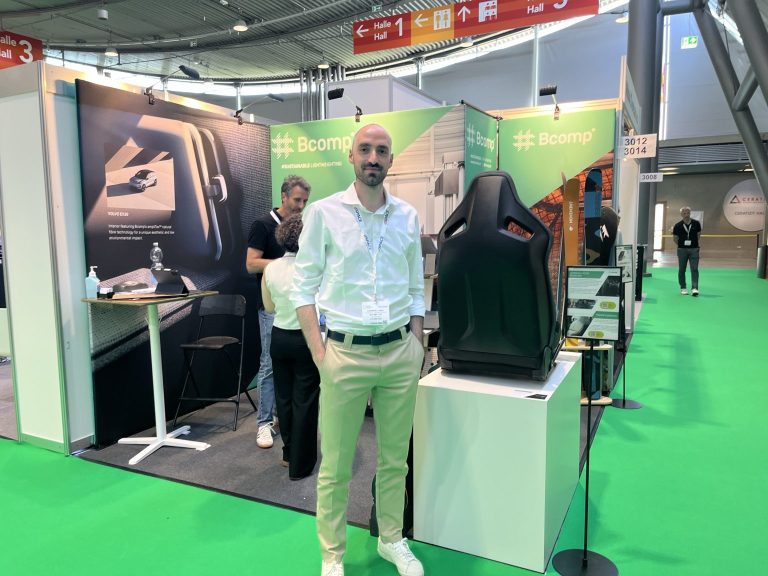
Bcomp has played a quiet yet significant role in the development of the BMW M Concept Neue Klasse, with its high-performance sustainable materials featured throughout the vehicle, inside and out. AIW caught up with Carmine Landi, automotive customer project engineer at Bcomp, at Automotive Interiors Expo (June 23-25, 2026) to discuss the company’s approach to vehicle interiors and its ‘from race to road’ approach
How has the push for sustainability changed vehicle interior design?
The automotive sector’s transition to electric vehicles brings with it a shift in focus. For combustion cars, the engine was the primary focus for reducing fuel emissions, whereas with EVs, the powertrain offers fewer additional emissions-reduction levers, so the real opportunities lie now particularly in the materials and their impact across the full lifecycle of the vehicle.
Sustainable materials have different properties to traditional materials. How has Bcomp designed around that challenge?
We have designed and engineered our high-performance solutions to be fully compatible and integrated within existing and established manufacturing processes used across the automotive industry. Whether that’s back-injection molding (one of the most common process for interior trim parts), compression molding or resin transfer molding, our materials can be used as a plug-and-play (solution). Thus it’s the same process, with innovative high-performance sustainable materials. We also meet the industry standards, such as IATF 16949, which govern quality management in automotive manufacturing.
Motorsport technology filtering down to the consumer – tell us more.
This race-to-road strategy is one that we have been implementing for many years now.
In motorsport, the go-to-market timeline is much faster. There’s the opportunity to develop, innovate and then test within weeks, and the requirements are different too. Depending on the race series, a part might only need to survive one race before it’s replaced, rather than having to last 20 years on a road car, for example. This is what makes motorsport such a valuable testing ground enabling the technology transfer to road cars.
The collaboration with BMW is a perfect example of that race-to-road success. We started with them on a single part for their Formula E car, then moved into DTM, then into the GT4 car. And now, Bcomp’s high-performance natural fiber materials will be used extensively in BMW Group series production for exteriors and interiors. Most recently, BMW presented the M Concept Neue Klasse, featuring Bcomp materials on various exterior parts including the roof but as well interior components.
Electric vehicles are reshaping what interiors look like. Can you give us some examples?
Automotive interiors are becoming key differentiators for brands. Consumers are looking for an experience in the inside and this can be shaped by a combination of factors including materials choice. Examples of visible interior components for series cars featuring Bcomp’s materials are the Volvo EX30, the Polestar 5 and the Cupra Born VZ.
We’re also closely collaborating with major OEMs, including Kia, whose latest concept car features Bcomp’s materials, the Vision Meta Turismo released at the Milan Design Week 2026. The BMW M Concept Neue Klasse foreshadows what will be seen in the near future on BMW M series cars.
What has been the biggest challenge in convincing OEMs to replace traditional plastics?
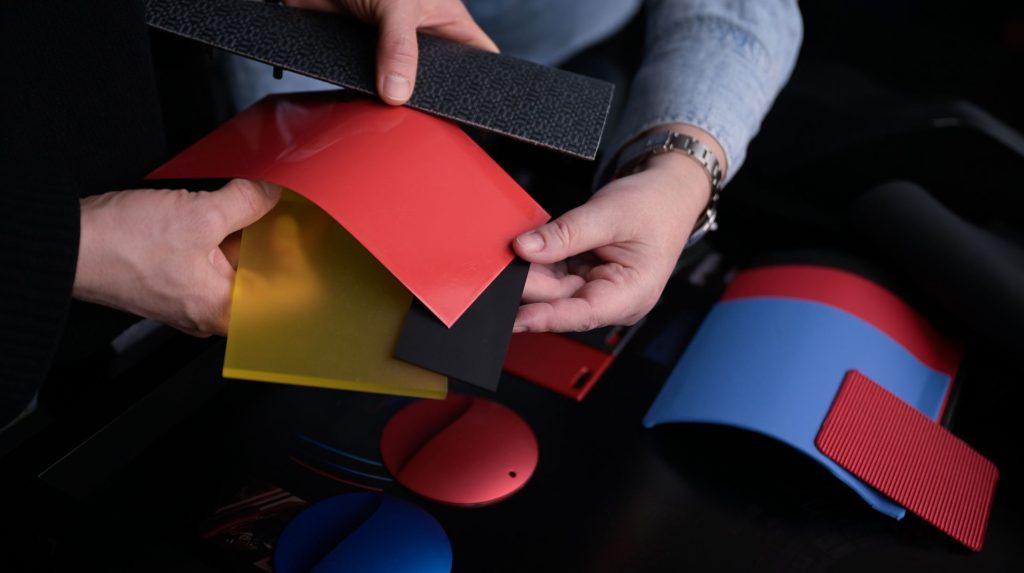
One of the biggest challenge in adopting bio-based materials is people’s perception. The term “natural fiber” often brings to mind something soft or inconsistent but this is a misconception. Our materials are not raw fibers, they are highly engineered composites, where natural inputs such as flax are carefully processed to create parts with reliable mechanical properties.
In practical terms, this means these materials are designed to meet the same performance criteria as conventional alternatives like carbon fiber or plastics. Engineers often prefer to work with established materials, but they should be open to innovative materials such as AmpliTex and PowerRibs that have been thoroughly validated, tested and proven under high pressure and at scale.
Is there anything you would like to say to the industry?
At Bcomp, we help our customers decarbonize their supply chains with high-performance bio-based materials. We work closely with them through to successful launch, and when our support contributes to their success, it becomes a personal success for us too. Performance, function and aesthetics no longer have to be a trade-off, and we hope more OEMs take this into consideration, especially in an increasingly crowded EV market.
Related news, Bcomp supplies biocomposites for BMW M Concept Neue Klasse