


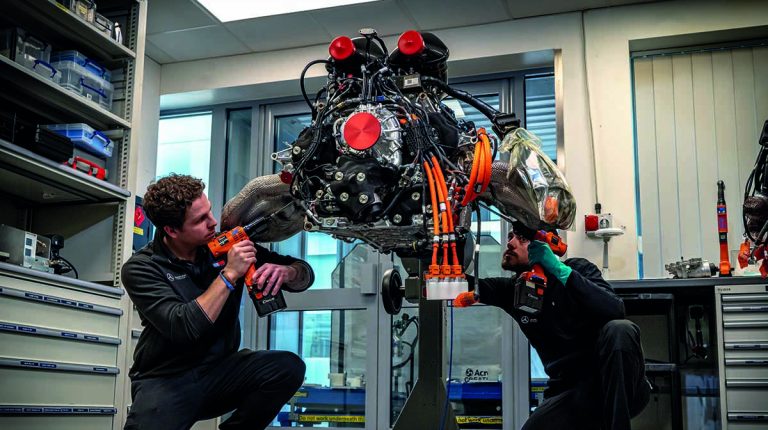
Lawrence Butcher looks at the development of the Mercedes-AMG One road-legal hybrid hypercar
Until recently, no one had ever successfully built a road car around an F1 engine. There have been close tries, and engines from race cars have ended up fitted to road cars in modified form. Porsche’s Carrera GT took the base engine from the company’s RS Spyder LMP. Going the other way, BMW’s 1980s M12 F1 engine used a road-car block. But taking an unadulterated F1 engine and putting it in a road car had never been done, until Mercedes decided to do the unthinkable. The result? The AMG One.
The genesis of AMG One began in Mercedes’s dominant 2014 and 2015 Formula 1 seasons. The 1.6-liter V6 turbocharged hybrid power unit (PU) that powered Lewis Hamilton to consecutive Drivers’ World Championships was, by any measure, a generational piece of engineering. To celebrate and capitalize on this success, Mercedes and AMG began exploring the concept of a road-legal hypercar using the W06’s powertrain. The main questions: Was it even feasible and, if it were, how much of the F1 PU could survive the transition to the road intact?
Toward the end of 2015, a small group at Mercedes AMG High Performance Powertrains in Brixworth, UK – specifically what is now called the Advanced Technology group – began concept work, sketching out what changes would theoretically be required before the program formally launched in 2017.
Mercedes-AMG’s plan was to produce 275 cars, the highlight of which would be an essentially unmodified F1 PU: the 1.6-liter turbocharged V6 ICE, the MGU-H harvesting energy from the turbocharger, and the MGU-K recovering energy under braking from the rear axle, plus an additional pair of electric motors driving the front axle. The combined system would output over 1,000hp. Getting that package through European road-car homologation was far from easy and pushed even the team at HPP – a group well used to achieving the impossible – to the limit.
Powertrain preservation
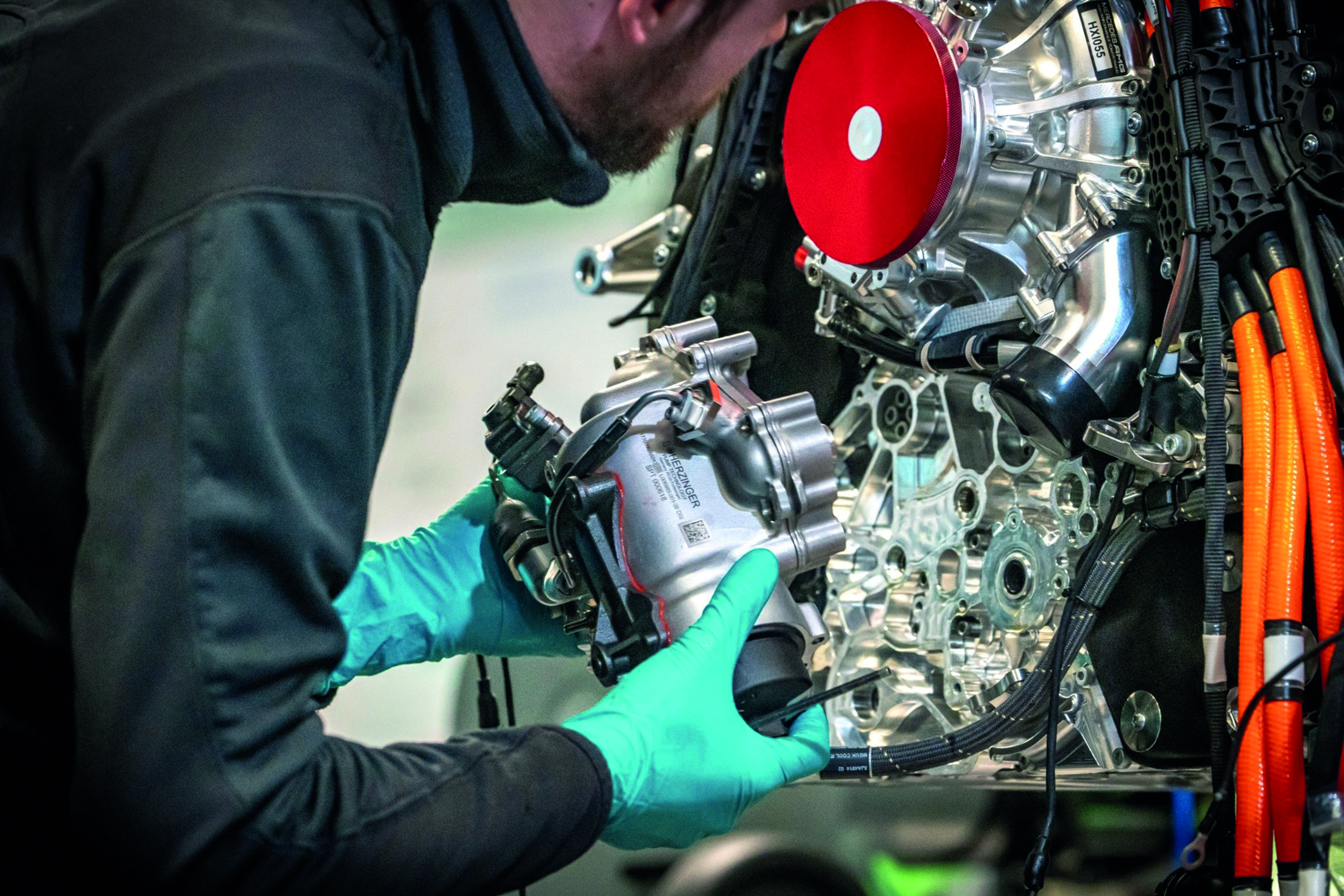
Adam Allsopp, currently director of Advanced Technology at Mercedes AMG HPP, was deeply involved in the powertrain development. When the project began, he was engineering director on the Formula 1 program, but in 2018 he became increasingly engaged with the road car before becoming sole program lead in 2019. According to Allsopp, there was an almost single-minded pursuit of keeping the powertrain “pure” and only departing from the racing design where absolutely necessary.
“Wherever we were faced with difficult challenges, if the solution was going to move us away from what the regulation specified for that engine, that troubled me because it felt like we would be watering it down,” he recalls.
Changes to the fundamental ICE architecture were to be avoided wherever possible – a tall order, given that the F1 ICE was entirely optimized to produce maximum power and efficiency within the fuel-flow-limited constraints of the F1 regulations. From the oversquare bore to stroke ratio, injector position, spark plug location, intake port geometry and cam profile, everything was developed for top-end performance and efficiency. But AMG One would be a road car; it needed low-speed manners and, importantly, noise and emissions compliance.
The Advanced Technology team at HPP took the approach of augmentation rather than alteration. Where the F1 architecture created a problem, the team sought solutions that worked around the core design. “It was about protecting those attributes and then trying to work out how you enhance rather than remove,” says Allsopp.
The eventual addition of port fuel injection alongside the existing direct injection system is a prime example of that approach in action. Rather than revising the combustion chamber, port injection (coupled with some subtle changes to the intake port geometry) improved fuel atomization and mixture preparation at low speeds, and aided stabilization of combustion at idle and light load without touching the high-speed combustion strategy.
Also supporting low-speed running was a redesigned throttle, in which the original barrel throttles were replaced with more traditional butterflies. “At high speed, it’s still got the same combustion philosophy,” Allsopp says. The idea of implementing variable valve timing (banned in F1) was floated to reduce low-speed emissions. However, although this would undoubtedly have helped, it was rejected to protect the DNA of the ICE.
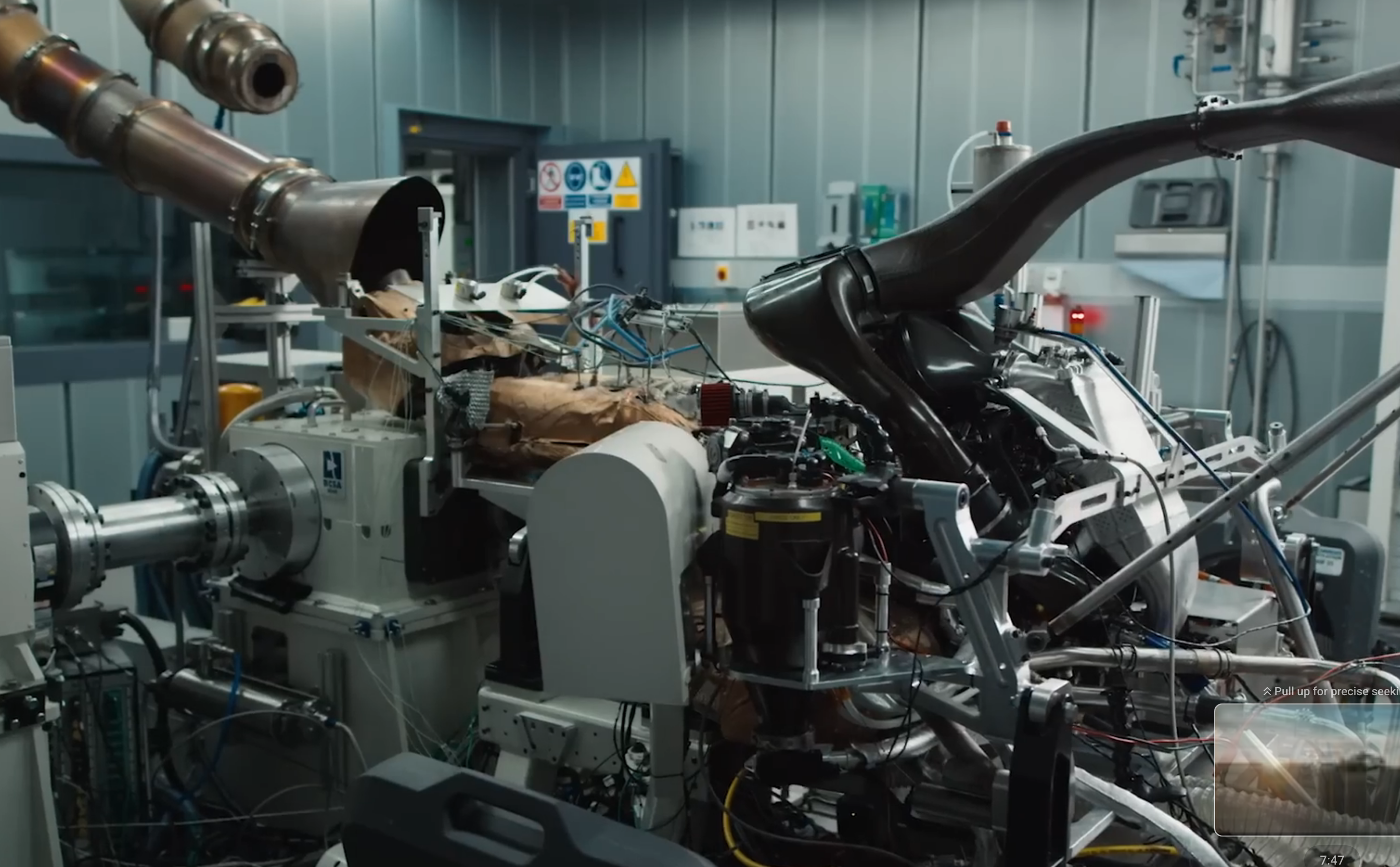
Another tool that could be called upon to help with low-speed emissions compliance was the MGU-K, used to load the engine at low RPM. By harvesting energy from the ICE and directing it into the battery at light throttle, the team could maintain engine load at a point where combustion quality was acceptable. A quirk of this approach is that AMG One will not run its combustion engine if the battery is full, because the MGU-K loading strategy requires somewhere for that harvested energy to go. “It sounds a bit weird and a little bit counterintuitive,” acknowledges Allsopp, “but really it was about using the tools at our disposal to work out how this over-constrained problem could be solved.”
Cold-start emissions were also addressed, partly through catalyst preheating using the car’s high-voltage electrical system, a solution made practical by the available battery capacity. What couldn’t be tackled at source was handled through exhaust aftertreatment.
Electrical hurdles
The purity of purpose applied to the ICE was carried over to the electric machines. Initially, the race- specification MGU-H and MGU-K were simply swapped into the production PU, with two MGU-Ks deployed on the front axle. However, the reality of producing a relatively large run of these motors and ensuring they were fit for road use presented a few challenges.
The rear-mounted MGU-K was kept exactly as on the race car, directly driving the crank. At the front, a pair of MGUs was packaged with reduction gears to create what is referred to as the MGU-Fs. The electric machines run at very high speed: 35,000rpm for the rear and around 50,000rpm at the front. The motors are oil cooled, with two separate cooling circuits; the rotor is cooled using engine oil (and gearbox oil at the front), and the stator by a second loop that also incorporates the inverters.
It was in the motors that one of the project’s biggest hurdles emerged: NVH. Jack Mowat-Maconochie, now head of supply chain for the Advanced Technology group, observes, “In 2018 we started the drive-by noise testing. We knew the engine to be loud, but the electric machines were incredibly loud as well.” So loud, in fact, that they would never pass muster for road use. A solution was needed, but the source of the noise needed to be pinpointed first.
It was established that there were two key culprits: the gears in the front-axle fixed-ratio gearbox, and the electrical characteristics of the electric motors. The first was relatively straightforward to overcome, with detail work on the micro- and macro-geometry of the gears bringing the noise within tolerable margins. A similar process had to be undertaken on the ICE, which features a gear-driven camtrain positioned directly behind the driver, and initially proved a little too aurally aggressive.
The electrical element of the noise problem proved more troublesome and required an almost total rework of the motor architecture. “I was fiercely against changing the motor,” says Allsopp, who felt that doing so would detract from the overall ethos of the car. But the decision was effectively made for the team: “It was actually some of the NVH experts from AMG who said, ‘Look, here’s the data. You might not want to do this, but you will not sell this car with this motor.’ It’s quite hard to argue with that.”
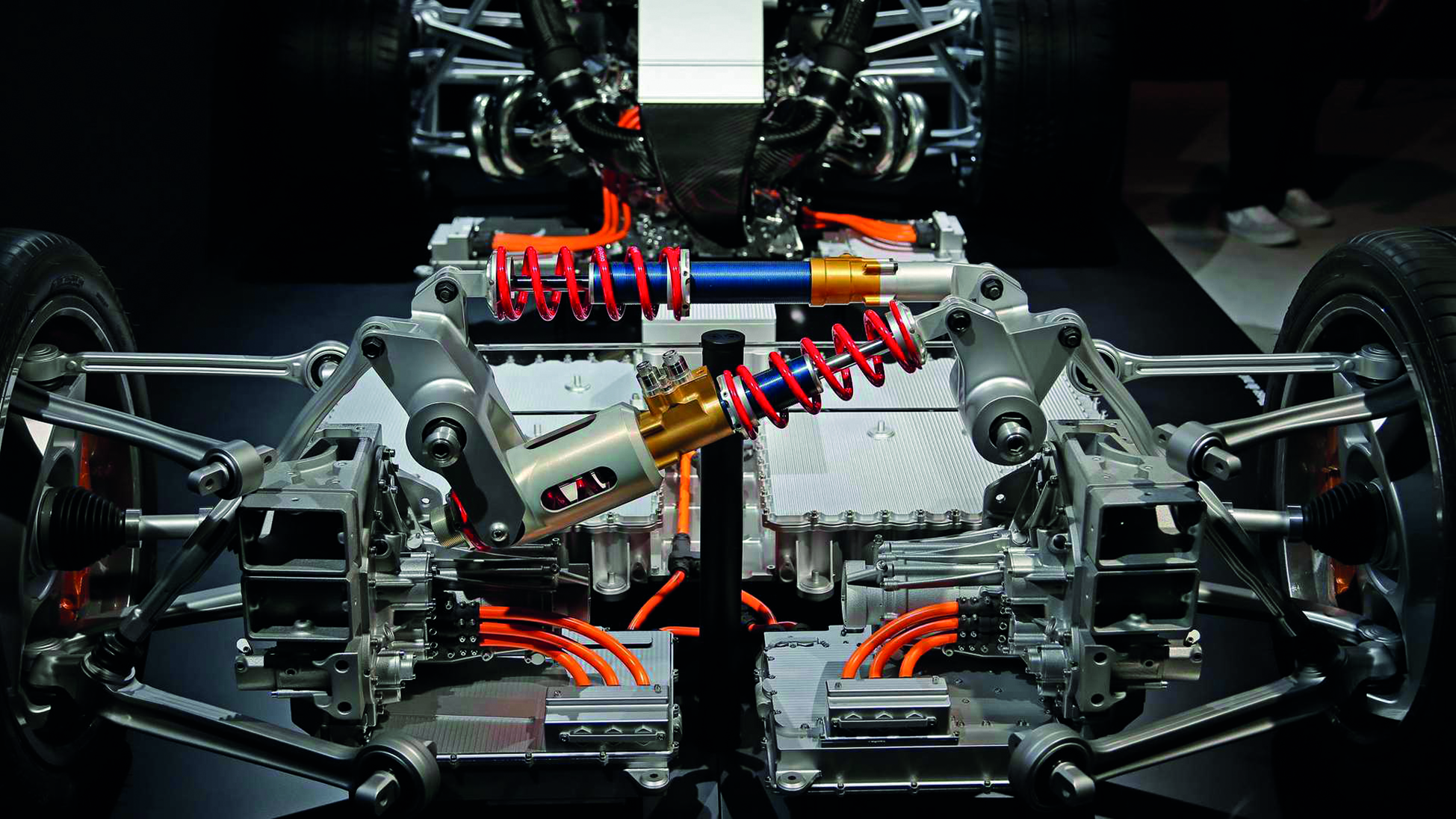
Again, the easy option would have been to move away from the constraints originally set by the regulations, transition to a larger-diameter motor, reduce the RPM and cut the power. Instead, HPP set about reengineering the motor to fulfill the same brief as the original, but in an NVH-compliant way.
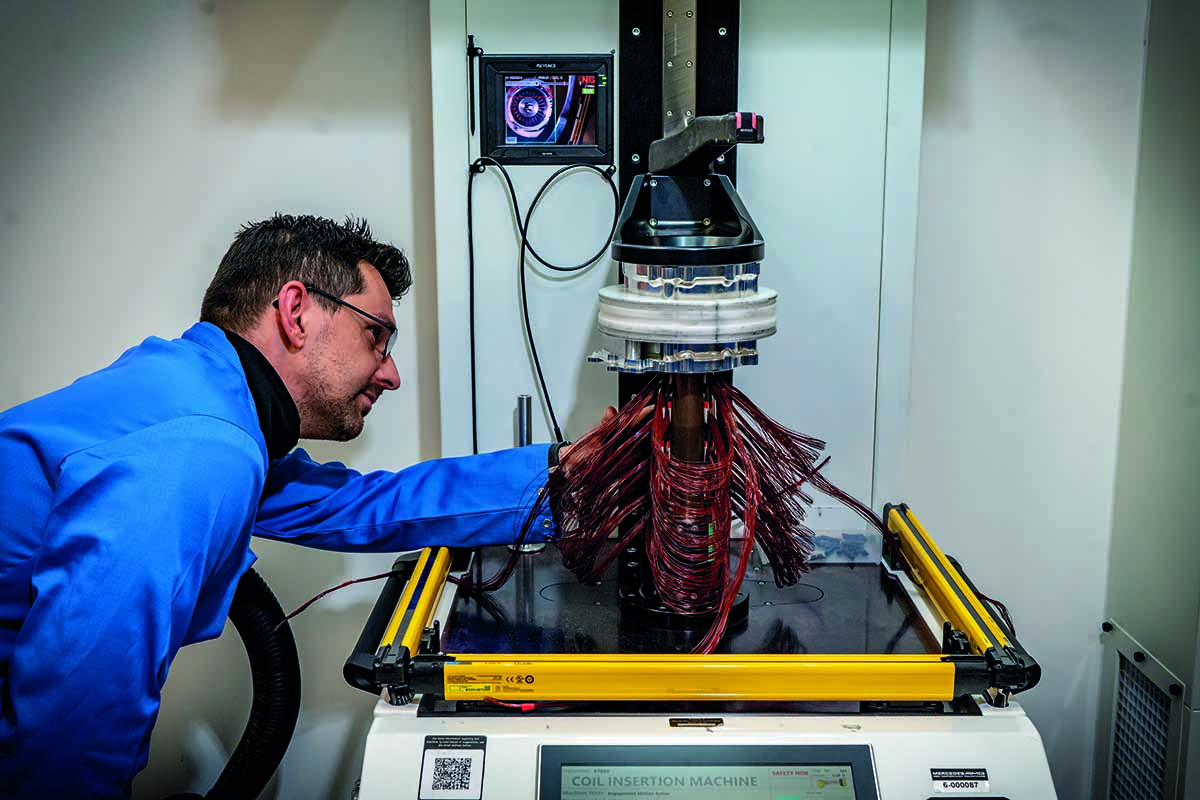
The result was an electrical redesign within the same packaging space, moving from a six-slot to a 24-slot architecture, as well as changes such as replacing Litz wire with more conventional windings. Coupled with revised magnet selection, a revised casing and the gear improvements, the result was a system that retained the spirit of the F1 units while meeting the stringent road-car legality requirements.
The new electrical design was also transferred to the rear MGU-K. “They’re identical,” says mechanical engineer Mark Digby. “They use the same rotor, stator and winding setup. They’re just packaged in different external housings to connect to the engine block and front gearbox respectively.” The choice to maintain commonality front and rear was a pragmatic one. “It was done to try to maximize commonality, so we are not making lots of different types of rotors and stators, given we had to produce more than 900 of them,” notes Digby.
From an F1 perspective, a run of this volume counts as mass production and required HPP to find a more efficient manufacturing process than the painstaking, largely manual approach used on F1 PUs. To this end, the engine maker developed automated in-house production capability for the rotors and stators, enabling repeatable production of motors regardless of the quantity required. “We were hand-winding them initially, and that was just not sustainable,” recalls Digby.
Continued in part 2 …
Related news, Mercedes-AMG One breaks its own lap record at the Nürburgring-Nordschleife