


Lawrence Butcher looks at the development of the Mercedes-AMG One road-legal hybrid hypercar
One interesting point is that during the development of AMG One’s powertrain, there was minimal influence from the F1 side of HPP, despite the ongoing development of the racing PU. The ICE and associated systems were effectively frozen at the 2015 specification and later developments were not incorporated.
However, there was one key exception: the MGU-H. During the 2016 Formula 1 season, Lewis Hamilton suffered MGU-H failures at the Chinese and Russian grands prix. Those failures were traced to a turn-to-turn short, believed to be from a production difficulty in the winding process. “We had fundamentally made it very, very hard to make right,” says Allsopp. “We were too aggressive on the engineering and on how the coils were wound and interacting, so it was not a sufficiently robust, repeatable process.”
Using HPP’s comprehensive fault-management process, a thorough fault analysis followed each race failure, which extended to examining the behavior of everything associated with the motor, including the silicon carbide switches in the power electronics, their switching frequency and the potential effect of that on the coil insulation under extended running. Fundamental design changes were made for the 2017 season. When Allsopp took over the AMG One program, he was determined that the 275 production cars would carry the post-2016 design, not the unit that had failed in race conditions.
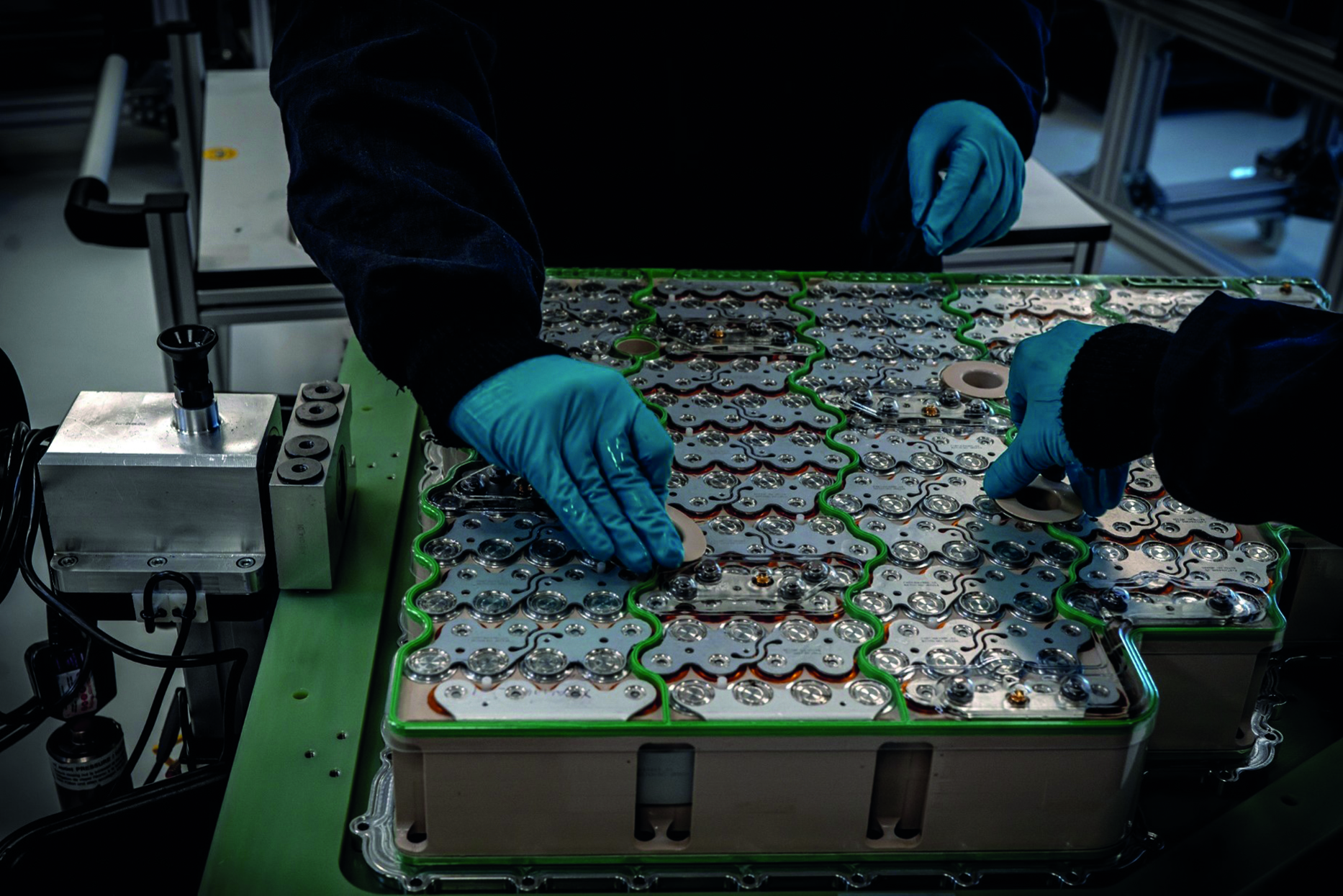
The battery pack has the same cell chemistry and design used in Formula 1, configured as the equivalent of four F1 battery modules in parallel. One significant difference from race use is that the AMG One must balance each of its cells on board.
In F1, the battery is removed from the car after each race and the voltage of each cell is checked and aligned. Clearly this is not practical for a road car, so the BMS needed its own balancing capability.
Bringing all the powertrain elements together from a software perspective, with full compliance to the required ASIL standards, was an undertaking in itself. “Looking at the complexity of the software, it was an area we underestimated,” says Allsopp. “We have the benefit in racing that the software is very open and we can architect solutions very quickly. With production controllers, it is not that simple.”
AMG One ended up running a blend of bespoke software solutions developed by HPP (and its partners) and standard road-car elements. Development engineer Adam Munday explains, “We did use some Bosch solutions where we maybe didn’t have the expertise – things like lambda sensor dew-point calculation and a lot of the OBD functions. They are areas where we are not experts, but for someone working on other road-car programs it’s a matter of adapting proven functions with some hardware-specific adjustments.”
The software integration required huge effort and coordination between the various parties within Mercedes, but the result was all of the control units working together harmoniously, tied in with a UI that would be familiar to any Mercedes road-car driver, and a powertrain operating to its full potential, reliably.
Hybrid development
The reliability requirements for the AMG One were rigorous: 5,000km between services and 50,000km between major powertrain services and refreshes. To put this in perspective, the 2015 PU had a total service life of around 5,000km.
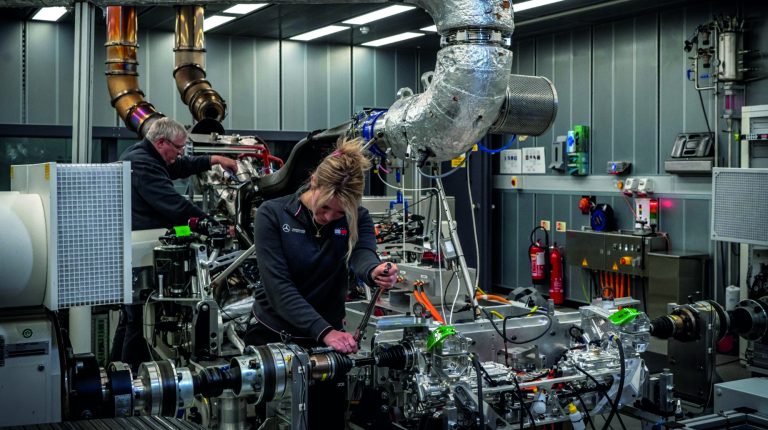
Achieving these targets, not just for the powertrain but for the vehicle as a whole, required a blending of motorsport and production-car development approaches. In the motorsport world – particularly in F1, where track running is tightly limited – great reliance is placed on test-bench development, far more so than with road cars. For the AMG One, this entailed two dedicated test cells at Brixworth: one for calibration development, the other capable of full powertrain running, “Dyno seven was dedicated for AMG One use,” says Munday. “For durability running, it was especially useful to run the full car powertrain as a whole.”
 Once an initial specification had been derived from the F1 PU, the team worked through multiple iterations, some more significant than others, to prove out each batch of changes. These test iterations “followed our F1 naming convention, starting with B1, 1.1, etc; we ended up at B2.3,” explains Munday.
Allsopp says of the project progression, “Dyno running moved to 24/7. In F1, we track our long-run progress against time. We have a well-defined profile and drive its delivery hour by hour, day by day, relentlessly. All I did was take the same engineering approaches we used in F1, clarified the mission and shared my honest assessment that in reality we were a long way off track versus where we need to be. We then built an aggressive plan and worked tirelessly as a team to get our heads above water.”
This intensive cycle of iteration and running ultimately led to a roadworthy powertrain, though there were nuances in the process, again highlighting how the high-pressure environment of F1 drives creative and concurrent thinking. “We created several phases, because there were some changes we could implement more quickly than others – for example, those related to the NVH and emissions challenges – so we packaged them in phases to prove out the durability of those changes in a controlled manner,” says Allsopp.
Importantly, a second dyno was available in parallel to focus purely on combustion development. This ability to run combustion and durability programs simultaneously was essential to the compressed timeline. However, what the dyno or simulation could not replicate exactly were the many edge cases that the car would be subjected to in customer hands.
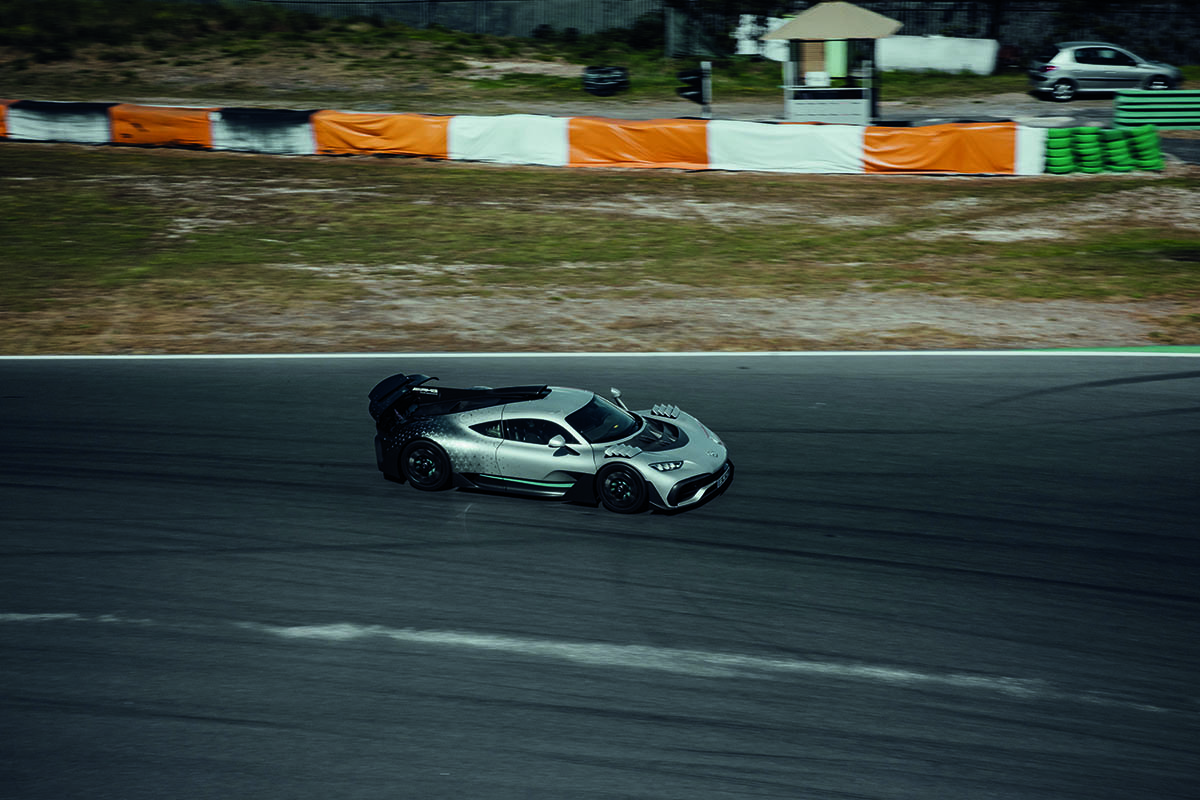
Once mule cars became available, an intensive program of track and road testing began. This encompassed running across a range of conditions, from the European Alps to Portugal and Spain, enabling refinement of the powertrain calibration under real-world conditions. The track-testing element also flagged up potential reliability issues. For example, a weakness was found in the quill shaft connecting the front motors to the front-axle gearbox. Pushed to the limit on track, specifically when running over curbs, it produced oscillating loads that were not captured in any of the previous simulation models.
Elements such as cold-start performance, handling variations in fuel quality, and the full span of duty cycles from slow urban driving to sustained full-performance operation were all worked through, with the findings fed back to the test-bench work at Brixworth.
It was during this phase that the teams at HPP and AMG took their collaboration to a new level, blending elements of the race team’s approach with testing with road-car practice. The contrasts are worth noting. For all its heat of competition, F1 is a relatively controlled environment; the teams know where the cars will run and how the drivers are likely to drive them. The range of unknowns of road-car use were something of an alien environment. “There was quite a difference in expectation of what was done where,” says Allsopp, “and it was a really good conversation with AMG. We were challenging each other about what needed to be done, and actually the middle ground ended up being the right place.”
Bringing AMG One into reality was a protracted process. There’s was a reason no one had successfully tried to run an F1 powertrain on the road before: it’s unbelievably challenging. The first customer deliveries were not made until the end of 2022, which one might think would lead to dissatisfaction. But AMG did something unusual: it took its customers along for the ride. Rather than being shielded from the challenges of the project, customers were brought in early and given full visibility of the development process; they felt invested in it. “They became part of the journey and, later in the program, had great transparency of why there were delays and what we were doing about them. It gave them a unique experience,” says Allsopp.
It’s unlikely anyone is going to try anything similar to the AMG One any time soon; there are few manufacturers that could even contemplate such an undertaking. It was only by blending the huge resources of a company the size of Mercedes with the laser-focused mindset and almost unmatched engineering expertise of HPP in Brixworth that AMG One could become reality.
Related news, Mercedes-AMG One breaks its own lap record at the Nürburgring-Nordschleife