


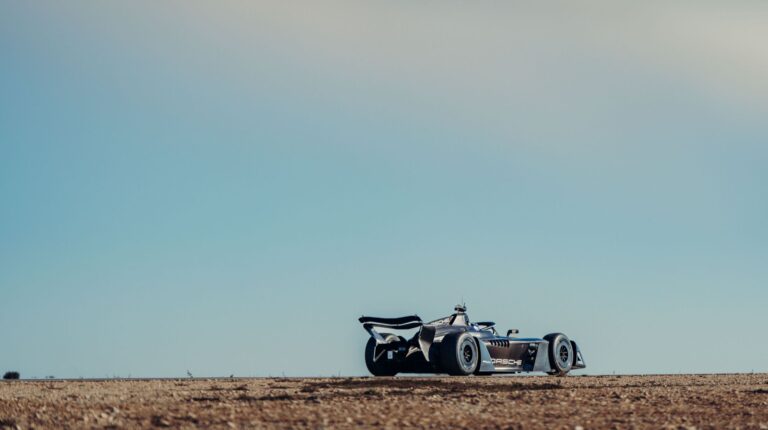
Porsche Motorsport has provided an update on development of its next Formula E race car, which has been undergoing testing since November 2025.
The new all-electric single-seater Gen4 Porsche complies with the ABB FIA Formula E World Championship’s fourth-generation vehicle regulations and features up to 600kW (804hp), permanent all-wheel drive, new tires and significantly increased downforce, representing the largest performance step in the series to date.
The Formula E Gen4 car is scheduled to debut in the 2026/27 season.
Porsche’s in-house vehicle components have been designed to be lighter, deliver higher performance, reduce costs and offer a longer service life. Development of this hardware package – Porsche’s most extensive package for Formula E to date – will continue until October, at which point the focus will shift to continuous software optimization. In many ways, the development cycles in the series mirror those for Porsche sports cars, albeit under extreme conditions.
“In Formula E, we primarily develop the technical components that are relevant for our production sports cars,” said Thomas Laudenbach, head of Porsche Motorsport. “That is one of the reasons why we compete in Formula E.”
With the introduction of Gen4, Porsche’s in-house development scope has expanded to include two additional components: the DC/DC converter and the brake-by-wire system.
In-house developments by Porsche to date include the operating software, pulse inverter, electric motor, gearbox, differential, drive shafts and other drivetrain components on the rear axle. Cooling, carrier and suspension components at the rear also come from Porsche.
“With the current car, the efficiency of our drivetrain is over 97%. From the battery to the wheel, less than 3% of the energy used is lost – close to perfection and a key advantage of electric drive,” said Florian Modlinger, director factory motorsport Formula E. “In our development brief for Gen4, alongside further efficiency gains in the drivetrain components, we focused on potential in terms of weight, durability and costs – similar to EVs for the road.
“At the same time, 600kW represents a 71% increase in power in Attack Mode. Overall, I believe it is fair to speak of a revolution. Seeing the car on track for the first time with its acceleration was a real pleasure. My thanks go to the development team in Flacht for this milestone in the project.”
Triple pressure: Gen3, Gen3 Evo and Gen4
By mid-January, the Gen4 Porsche had completed almost 915 test miles on the circuits of Monteblanco and Almería in Spain. A large proportion of the development and testing work, however, has taken place – and continues to take place – in the simulator.
“The concept phase began in 2024. In the same year, we moved into simulator work. The project therefore started during Season 10, when we were still racing the predecessor of the current Gen3 Evo, the Gen3,” Modlinger said. “At the time, we fought for all three titles right to the end, secured the Drivers’ Championship with Pascal – and at the same time developed the Gen3 Evo. We work in an agile way, similar to series-production projects: you run the existing vehicle, bring the facelift to market and already design the next generation. The difference is that our cycles are shorter and our budgets smaller – with maximum pressure to succeed. After all, we are contesting an FIA World Championship for Porsche.”
Porsche said that in the early testing phase, development focused on ensuring reliable operation and smooth interaction of all components. Over time, attention shifts toward performance. With Formula E’s limited test days, some findings are validated in a simulator. Porsche’s Customer team is also testing the new car ahead of FIA homologation, scheduled for the autumn.
Related news, Schneider Electric becomes McLaren Racing energy technology partner