

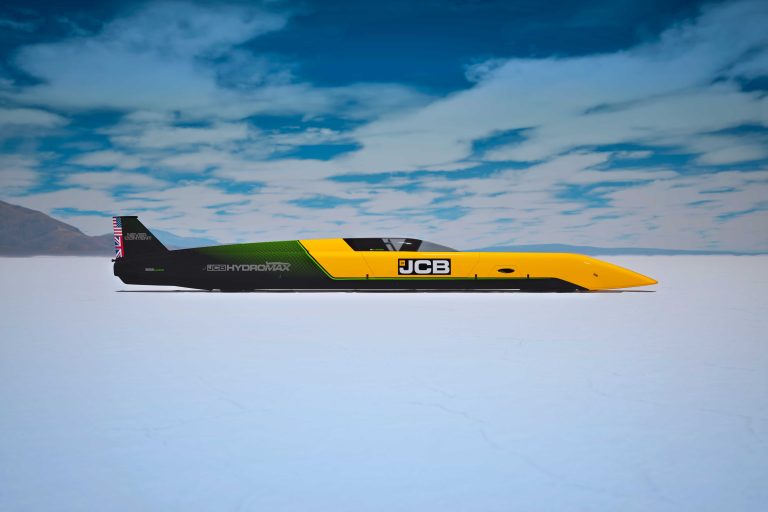
JCB, the UK-based manufacturer of excavators and other off-highway equipment, is to return to the Bonneville Salt Flats 20-years after securing the world land speed record for a diesel car with its Dieselmax streamliner. Back in 2006 its LSR adventures were to prove out its in-house diesel engine technology, in 2026, it looks to repeat the feat with hydrogen power, using the all-new Hydromax streamliner.
JCB has been working on the development of hydrogen ICE engines for the past five years and has now introduced them into production. It will be these engines that form the basis of the Hydromax’s powertrain. “It’s incredibly strong and incredibly robust,” says chief engineer, Lee Harper. “So, when we’re chucking very high boost pressure at it, it’s great because it will take it all day long. It’s built to last forever.” This is fortunate as the output of the engines will be increased from around 85bhp to 800bhp, with the JCB team working in conjunction with Ricardo on development, which has focussed on increased boost (via bespoke, single stage turbochargers) and combustion improvements.
Impressively, the stock block, crank and even most of the valve train is retained. “The valve train dynamics have been excellent, and no issues at all with life. In fact, we haven’t changed anything drastically in any of the valve train, which is where the typical risk areas are. That has kind of surprised us and delighted us.”
The engines will be housed in a streamliner body built around a tubular steel chassis, developed in conjunction with Prodrive, with a pair of six-speed transmission provided by Xtrac, mated to JCB bellhousings and, surprisingly, JCB clutches. The engines are laid flat, to reduce frontal area with dry-sump oiling to handle lubrication. A water/ice cooling system will be used, as radiators would carry too great a drag penalty and the car will use around 250kg of ice per record run come August.
The team has drawn heavily on the experience with Dieselmax, and though consideration was given to using the old chassis, it was deemed that an all-new build would be a better approach. As a result, though the general layout is similar, the new car is longer and has a more driver-forward setup, alongside considerable refinements to the aerodynamics and, most importantly, the tire package.
In 2006, the available tyres from Goodyear were only rated to 300mph, with further testing – aided by NASA – proving they were sound up to 350mph, which became the hard limit for the record run. In a major move, JCB has worked with Goodyear to develop a new LSR tire, and although its maximum speed rating has yet to be revealed, it is well in excess of the old rubber.
With testing of the car due to commence in the UK at the start of June, JCB plans to make its record attempts during Bonneville Speed Weeks in August. It’s stated aim so far is purely to ‘match’ the performance of Dieselmax, to prove the validity of its H2 ICE technology. However, it is well documented that the old car had the potential to run well over 350mph, and with greater power and lower weight, there is every chance Hydromax will eclipse its performance.
Look out for a full feature on the JCB Dieselmax streamliner in an upcoming issue of PMW magazine