


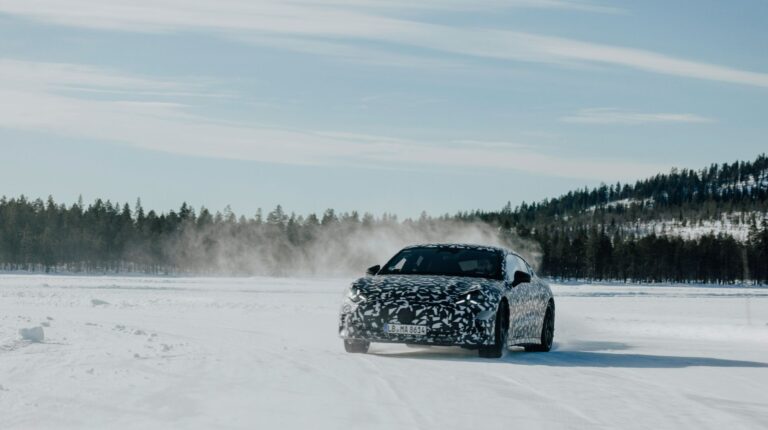
Mercedes-AMG has completed final winter testing of near-production prototypes of its new GT 4-Door Coupe in northern Sweden, ahead of the vehicle’s world premiere later this spring.
Testing at the Arjeplog facility focused on traction, power distribution and vehicle control on snow and ice, allowing engineers to evaluate system limits and refine control strategies under extreme conditions.
A key area of development is the new AMG Race Engineer system, which integrates hardware and software to enable detailed adjustment of vehicle dynamics. Three rotary controls allow drivers to tune response, agility and traction.
The Response Control adjusts electric motor response to accelerator inputs; Agility Control modifies cornering behavior by varying torque distribution, enabling transitions from understeer to controlled oversteer. A nine-stage Traction Control system regulates slip, building on technology used in previous AMG models. These functions are fully available with ESP disabled, targeting track use.
The model also introduces AMG Performance 4MATIC+ all-wheel drive in an all-electric configuration, using three axial flux motors. The system enables fully variable torque distribution between front and rear axles, as well as torque vectoring across the rear wheels. Sensors monitor wheel slip and adjust torque delivery in real time to maintain traction and stability.
The braking system combines carbon-ceramic discs at the front with steel discs at the rear in a hydraulic composite setup. Mercedes-AMG says this delivers consistent pedal feel across regenerative and friction braking scenarios.
Suspension development has focused on the AMG Active Ride Control system, which uses interconnected hydraulic elements in place of conventional anti-roll bars. Combined with three-chamber air springs and adaptive dampers, the system enables a wide range between comfort and dynamic performance while reducing body roll and improving cornering precision.
The vehicle’s drive system features three innovative axial flux motors and directly cooled battery cells, and was also tested under Arctic conditions. The battery uses directly cooled cells grouped into laser-welded modules, with a non-conductive coolant circulating around each cell. This allows rapid heating to optimal operating temperature and efficient cooling under load, supporting repeated high-performance use.
Mercedes-AMG’s winter test program forms part of a broader validation process. The entire test program for validating a new model comprises over 500 individual tests, supplemented by the specific tuning of driving dynamics and the ESP system.
In related news, Mercedes-AMG leverages Track Sport Concept for next-gen GT3 and Black Series