


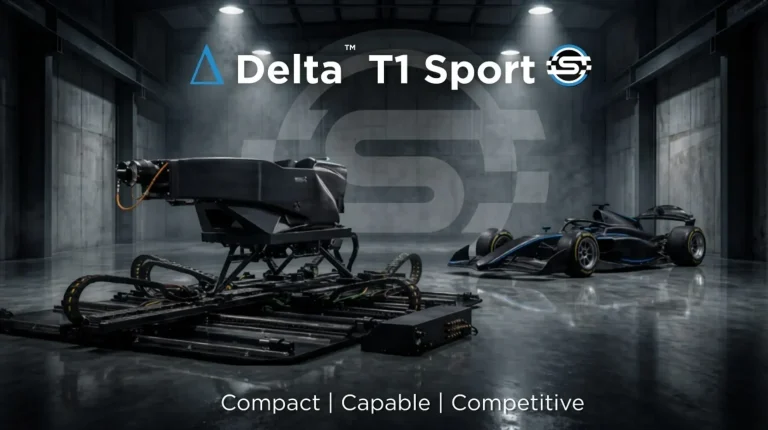
Ansible Motion has launched the Delta T1 Sport, a motorsport simulator designed to deliver high-fidelity vehicle dynamics, ultra-low latency and an immersive driving environment.
The first production unit will be delivered to Lola Cars to support its vehicle development programs, including preparations for its ABB FIA Formula E World Championship GEN4 campaign.
Optimized for single-seater and cockpit racing series, such as Super Formula, LMP2, LMH/LMDh, Formula E, F2, F3, F4 and Formula Regional categories, the Delta T1 Sport reportedly opens the door to engineering-class DIL capability for race teams, drivers and organizations where space, infrastructure, installation complexities and cost of ownership have traditionally been barriers.
The simulator features an all-new Triform motion system that blends a uniquely high mechanical stiffness and low dynamic mass, to deliver elite physics, along with trusted, repeatable, tunable motion performance, Ansible reports.
Dan Clark, Ansible Motion’s managing director, said, “Delta T1 Sport delivers the fidelity that drivers and engineers crave, in a compact, easy-to-install and operate, inclusive package that has not been available until now. This new class of simulator will unlock fresh opportunities for teams to efficiently pursue and extract vehicle performance gains by leveraging a streamlined, optimized approach. Our customers will benefit from best-in-class, combined solutions in terms of technical integration, technical support and value, with the freedom to distinctively configure aspects of their DIL simulation environment that ultimately lead to competitive advantages.”
Delta T1 Sport in Formula E
The first production Delta T1 Sport will be delivered to Lola Cars’ Silverstone headquarters. The British motorsport company will draw on the benefits of virtual development for its Formula E program, with a wider range of DIL-simulator-supported initiatives set to follow in the longer term.
Till Bechtolsheimer, chairman of Lola Cars, commented, “We are delighted that Lola will be the first user of the pioneering Delta T1 Sport simulator, which will efficiently connect to our existing workflows, enabling us to accelerate our engineering processes and improve development as we strive to drive innovation through motorsport.”
Peter McCool, technical director of Lola Cars, continued, “We do not underestimate the impact this technology will have on our car development, software validation and race preparation, for both Formula E and future projects.”
Scalable architecture
As the latest addition to Ansible Motion’s DIL Sport simulator portfolio, Delta T1 Sport follows the Theta Seat Sport (already trusted in Formula E) and Theta Cube Sport (used by a European motorsport customer).
The DIL Sport range is designed for motorsport engineering applications, offering high dynamic fidelity, ultra-low latency and enhanced driver realism. The system also supports seamless integration with racing software and hardware environments to help in vehicle development and testing workflows.
“Within six-degrees-of-freedom motion space, DIL simulators must, first and foremost, deliver sufficient ground-plane fidelity – especially for vehicle dynamics and motorsport applications, where vehicle directional control and stability dominate the virtual test-driving experience,” said Elliot Dason-Barber, Ansible Motion’s technical director. “Many simulators miss this fundamental point by starting with legacy hexapods and then working backward to sort out additional motion requirements with appendages that add complexity and cost.”
Compact, six-degrees-of-freedom motion system
At the core of the Delta T1 Sport is Ansible Motion’s Triform motion system (AML TMS1), which is designed for motorsport and high-performance simulation applications.
The system uses updated kinematics and motion generation technology, aiming to retain elements of the company’s Stratiform motion approach while reducing the overall physical footprint.
The Delta T1 Sport offers a payload capacity of up to 300kg, supporting drivers and racing cockpits, and provides a six-degrees-of-freedom motion system with 1m surge, 1.2m sway, 0.2m heave, 22° roll, 16° pitch and 120° yaw.
Ansible Motion says the motion envelope has been optimized based on its experience in DIL simulation, to support realistic feedback on vehicle dynamics, including handling, track conditions and stability.
The system also includes a configurable motion cueing package, allowing sensory feedback to be tailored to different racing series, driver profiles and vehicle setups.
This overall motion space is efficiently packaged within a low-mass, 2.4 x 2.4m floor footprint, which enables flexibility of location and operation without special facility or flooring requirements.
Salman Safdar, Ansible Motion’s business development director, said, “The Delta T1 Sport also includes a number of bespoke driver feedback and immersion systems to suit physical space, budget and performance requirements, as well as futureproofing and upgrade pathways. These include, but are not limited to, multiple space-efficient vision systems, including projectors, LED walls, extended reality (XR) and virtual reality (VR) options; configurable race car cockpits; active dashboard and steering wheel interaction capabilities; adjustable racing seats; configurable pedals; haptic and torque feedback for steering; and harness and helmet loading systems.”
In related news, McLaren unveils 2027 LMDh contender and limited edition track car