


* The original version of this article was published by Nissan Motor Corporation.
Nissan Formula E Team’s most important development tool isn’t the race car; it’s a state-of-the-art simulator helping to shape the team’s on-track success
Formula E race weekend. Over 9,000km from the circuit, a special ops team is working hard in the Nissan Formula E Team HQ in Paris, putting in vital and sustainable work to help drivers Oliver Rowland and Norman Nato secure more points in their pursuit of championship success.
Plenty about Formula E tallies beautifully with the advancing world of driver-in-the-loop simulators. The sport’s limited track testing time and its celebrated street circuits, which can’t be recced or rehearsed in any traditional sense, both ensure a state-of-the-art sim isn’t just desirable, it’s the bedrock of a successful team.
Tommaso Volpe, the managing director and team principal of the Nissan Formula E Team, explains, “With Formula E’s limited physical testing, the ability to run highly accurate simulations is crucial not only for race preparation but also for car and powertrain development. This new simulator is already helping us accelerate our engineering process, validate software and optimize the car long before we reach the circuit.”
A new dawn
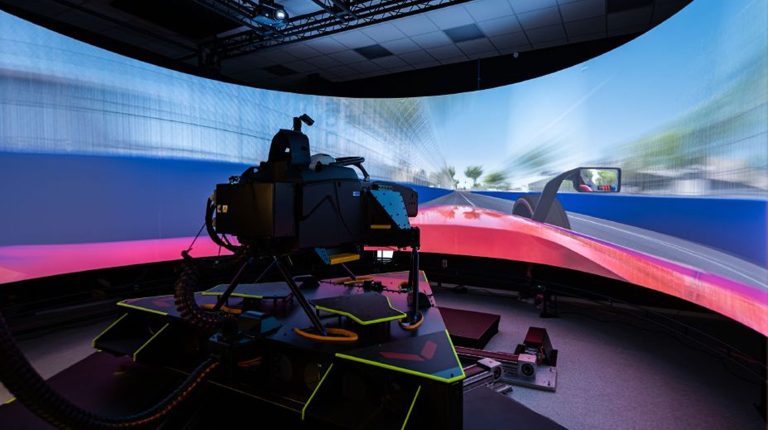
The Dynisma DMG-1, installed at the Nissan Formula E Team HQ in 2025, helps combat the frenetic pace of a Formula E race weekend. Drivers Oliver Rowland and Norman Nato can walk each track with their engineers on the Friday morning ahead of practice, feeding vital information they pick up on surface or corner geometry changes – to which the series’ temporary city courses can be especially vulnerable – directly back to the team’s Paris base so that their race tactics can evolve via the sim ahead of the physical car running on track.
A pair of British drivers are at the heart of Nissan Formula E Team’s sim work. Reserve and development driver Sam Bird puts in race-preparation work in the weeks ahead of a Formula E round, refining team strategies. As race weekend approaches, rookie and simulator driver Abbi Pulling can work antisocial hours to reflect the shifting time zones of the Formula E calendar, with races in São Paulo, Sanya and Tokyo all nudging 6,000 miles (almost 10,000 kilometres) away as the crow flies.
Volpe says, “Our official driver wouldn’t be able to jump in the car and put together their performance without the job that has been done by our sim drivers; it acts as a work of screening as we discover the best way to approach each race.”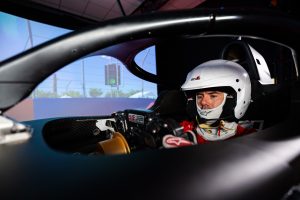
A state-of-the-art sim
Alongside Oliver, Abbi and Sam, the strong British connection in Nissan Formula E Team is galvanized by its Bristol-made racing simulator. The Dynisma DMG-1 is among the most advanced in the race series and a crucial component of both race preparation and future car development.
Dynisma’s DMG-1 allies an ultra-low-latency motion response (under 5ms) with high-bandwidth primary motion (up to 100Hz). This gives it the necessary precision and responsiveness for truly accurate setup work and engineering analysis.
This is vital in Formula E, when the nuances of powertrain system change between drive and regen needs to be precisely communicated to the driver. Any small shifts in the car’s balance are crucial for predicting its behavior through tight, twisting city courses where there’s typically zero margin for error. Curb strikes, weight transfer, vibrations and stability changes at the limit of grip are all essential cues for any sim driver.
Rowland comments, “In Formula E, we have very few test days and only two short practice sessions before qualifying, so what we achieve in the simulator is incredibly important. It helps us understand the track, prepare systems and arrive on race weekend ready to perform.”
Dorian Boisdron, the team director of Nissan Formula E Team, says, “The simulator is key not only to prepare for races but also to prepare our new cars. The DMG-1 is perfectly suited to our technical requirements, offering excellent realism and strong engineering support, in addition to our great working relationship with the Dynisma team, which helps us to progress quickly.”
Getting ready for GEN4
The Dynisma simulator forms a big part of GEN4 car development. The development of the GEN4 car’s dual motors and their active differentials is quicker and more informed thanks to the accuracy of the Dynisma DMG-1, helping to inform the engineering team’s decisions.
The fourth generation of Formula E race car represents a significant leap in performance, while permanent all-wheel drive and the debut of a power steering system ensure a major shift in driving dynamics over its predecessor. Preparation work on the sim is core to the sustainable progression of this thrilling new chapter for single-seater motorsport.
The race car delivers up to 600kW (816hp) in peak output, up from 350kW (476hp), enabling 0-62mph (0-100km) acceleration in 1.8 seconds and a top speed of 208mph (335km/h). According to the company, it is also the world’s first single-seat race car with permanent all-wheel drive.
Boisdron comments, “When you begin designing a new car, especially for GEN4, simulation comes first. You start with a sophisticated virtual model, but it is essential to put the driver in the loop as early as possible. The DMG-1 allows us to do that with confidence. Its realism and fidelity give us the best-possible chance of transferring performance from the virtual world to the track.
“The GEN4 car is very sophisticated. It is full of chassis systems and has the capacity to accurately control the motor. If you take it directly to the track, you have a low chance of quickly being in the performance ballpark; it requires so much track time. Preparation before each test means we are already in a good window to operate the car and as close to the peak of its performance as possible.”
A lasting legacy
Nissan has consistently embraced and celebrated the link between virtual and on-track performance, pioneering GT Academy in 2008 to bring gamers to the grid and prove talents fostered in a simulated world are directly transferable to the tarmac. Over five million entrants produced 21 winners, with podiums at the 24 Hours of Le Mans and race and championship wins at renowned events attesting their skills.
“It is exciting to see Nissan Formula E Team already gaining value from its new driving simulator,” Simon Holloway, Dynisma’s commercial director, concludes. “We are pleased to be working with Nissan Formula E Team as their official simulator partner and to support their preparations for GEN4, where advanced simulation will play a central role.”
EXPLORE: F1: Aeroelasticity in the age of active aerodynamics