


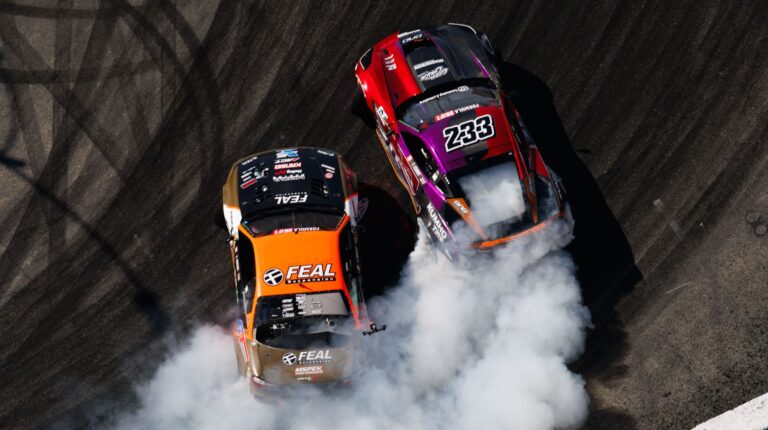
Following a partnership data and telemetry specialist Race Data Labs (RDL) and consultation with drivers, Formula Drift has announced changes to the race format for the 2026 season.
Formula Drift has a history of making changes to enhance the experience for teams and fans. After two years of the All-Tandem Qualifying format, the organizers held two driver summits to gather feedback and suggestions. Based on these discussions and the recent implementation of a reliable data and telemetry system from Race Data Labs, Formula Drift will adjust the format according to the preferences expressed by the majority of drivers in each championship.
The outcome
The majority of Pro Championship drivers voted to remove the All-Tandem Seeding Bracket Qualification format, which was used to seed the Top 32 competition places.
In an effort to accommodate the wishes of each championship, the Formula Drift executives had to consider that any format change requiring extended track time could necessitate cutting the number of drivers in either championship to ensure there was sufficient time for practice, qualifying and competition on “combined weekends,” where both Pro and Prospec Championships compete. Without making concessions, the return to the longer Two-Run Qualifying format could have led to major disruptions to the required practice and qualifying time prior to Top 32 competition.
As Single-Run Qualifying had proven insufficient, options for replacing the All-Tandem format in Pro were limited. In response, Formula Drift partnered with Race Data Labs to implement its UDSM (Universal Drift Scoring Method). The Australia-based telemetry company will automate objective elements of individual qualifying runs, enabling a return to Two-Run Qualifying for the Pro Championship within existing weekend schedules.
Under the new system, approximately 80% of a Pro driver’s qualifying score will be automated. The UDSM platform will quantify and score drift line and car angle. The remaining 20%, based on driving style, will continue to be evaluated by the three Formula Drift judges, as it requires subjective assessment of difficulty and driver errors. Style scoring will be separated from the automated categories.
In addition to supporting Two-Run Qualifying, the RDL system will be installed in all competition cars throughout the weekend. It will provide judges with consistent physical data during competition, including measurements of proximity, comparative angle and speed. The system will also quantify deceleration – building on the existing Decel Lights technology – and deliver clear data in the event of contact to help determine fault. It can also detect when a driver places one or more tires off course, simplifying position assessments.
Michael Vernuccio from Race Data Labs said, “Race Data Labs is beyond excited to integrate into the 2026 Formula Drift program. Our role will extend beyond traditional drift telemetry to help evolve the sport into a new era of digital judging. Our current UDSM system – a platform that supports drivers, teams, fans and competition operations, while evolving the process of judging itself – has been capturing drift telemetry for more than three years in 12 different countries, so its adoption by FD presents a new pathway for integration into the sport as a whole.”
Formula Drift president Ryan Sage added, “Michael and his team have created a truly powerful system. It’s been developed by highly talented operators who are drifters first, so UDSM carries the fingerprints of people who drift, and you can see that in its operation.
The RDL system will also be made available to the fans. “We can propel the sport forward by incorporating much of the UDSM data into our free-to-view livestream broadcasts,” Sage said. “By capturing, animating and dynamically transmitting the data, fans can share the robust backbone of the system and gain a greater understanding of the most nuanced motorsport series in the world.”
Related news, Red Bull Ford Powertrains reveals how metrology partner Hexagon helped shape its first F1 powertrain