


Molicel has launched the INR-21700-P70X cell, part of its PX series, to “bridge the gap” between lithium-ion batteries and supercapacitors, the company said. The cell has a stated capacity of 7,000mAh, energy density of 340Wh/kg and continuous discharge rate of up to 30C.
Molicel’s cells have previously been used in performance-focused projects such as the McMurtry Spéirling electric hypercar.
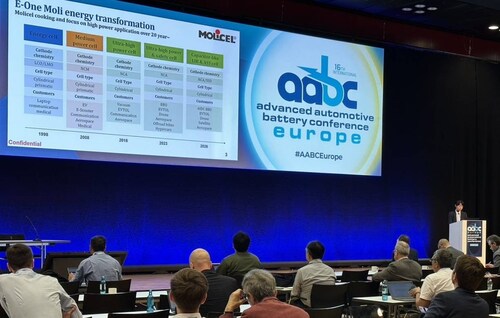
The cell was launched at the Advanced Automotive Battery Conference (AABC) Europe 2026 and comes as BEV growth slows and auto makers increasingly shift investment toward hybrid models. In its 2026 outlook, the International Energy Agency (IEA) highlights this shift, noting that manufacturers are actively prioritizing hybrids. In response, a surge in hybrid demand is redefining key regions: in the USA, hybrids neared 20% of new vehicle sales volume by late 2025 according to CNBC, while in Europe, they captured a 24% market share based on International Council on Clean Transportation (ICCT) data.
Concurrently, the Asia-Pacific region asserted its market dominance, capturing 51.67% of the global hybrid vehicle market value across all segments, including mild, full and plug-in hybrids. The multi-regional momentum is propelling the global hybrid vehicle market from US$335.21bn in 2026 to a projected US$570.78bn by 2034.
This market shift is changing battery requirements for next-generation hybrid vehicles, which demand both high energy density and high power output. According to Molicel, the INR-21700-P70X has been designed to address these requirements, delivering a peak power output of 900W for up to five seconds to support rapid acceleration, such as during overtaking, while also enabling high-power energy recovery under heavy regenerative braking.
The company also states that the cell can transition to high-power output in under 200µs, providing a response comparable to a supercapacitor and supporting repeated high-frequency power pulses with minimal performance degradation.
“The global automotive landscape is undergoing a profound diversification, where the demand for immediate, high-frequency burst power has become paramount,” said Casey Shiue, president of Molicel. “Our next-generation PX series isn’t just an evolutionary upgrade; by blending supercapacitor-like responsiveness with the high energy density of lithium-ion, we are redefining what hybrid powertrains can achieve in terms of raw power, safety and lifespan.”
The INR-21700-P70X has passed the UL9540A thermal runaway evaluation, a widely used safety test for energy storage systems. The company attributes the cell’s performance to its single-crystal cathode technology, which it says reduces exothermic heat generation by nearly 50% compared with conventional polycrystalline materials.
Molicel also stated that, during abuse testing, the cells emitted smoke rather than undergoing an immediate catastrophic rupture, helping to delay thermal propagation. The company said these characteristics are intended to enhance safety in applications ranging from data center battery backup units (BBUs) to next-generation hybrid electric vehicles (HEVs).
Furthermore, unlike BEVs that undergo deep daily cycles, hybrids subject batteries to hundreds of thousands of rapid, shallow fluctuations. In testing mimicking this environment under a supercapacitor profile, Molicel’s PX series retained 96% capacity after 1,000,000 cycles (+10C for 10s/-2C for 110s, cut-off temperature 83°C).
Recent news, Goodyear Racing’s FIA three-star environmental accreditation renewed