


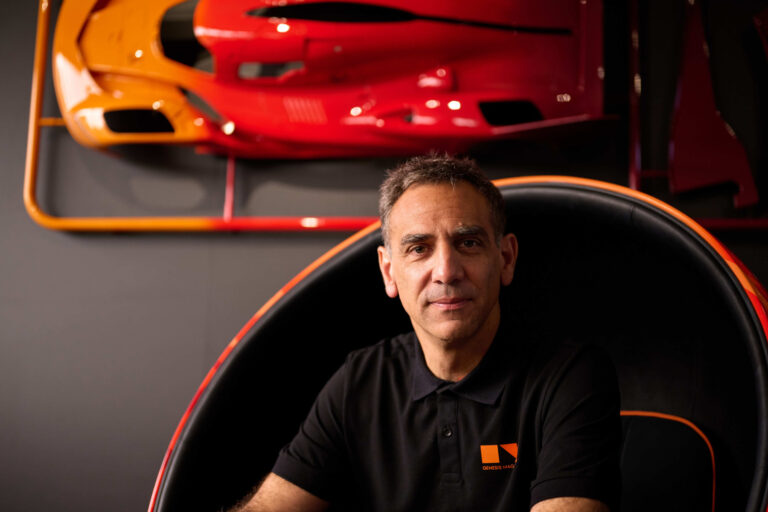
Since its launch in Dubai in December 2024, Genesis Magma Racing has established a full team, recruiting staff and drivers from across motorsport. Over the past year, the team participated in the Trajectory Program with the European Le Mans Series (ELMS) while developing the GMR-001 Hypercar for next year’s FIA World Endurance Championship. Team principal Cyril Abiteboul reflects on the progress made in 2025 and the work ahead.
Can you sum up how 2025 has been for Genesis Magma Racing?
It’s been a positive, busy and constructive year, in which we have not only delivered a great looking sportscar but also built a racing team and established a team base that will be crucial in preparing ourselves over the winter. So, in all these areas, it’s been busy, it’s been productive, but also very rewarding to orchestrate so much change in just one year.
What has been the most difficult part about building a team from scratch?
Building up a group of people is tricky, especially as we were creating a brand-new team in a new location. We had to find the people we wanted to bring in, but most of them were busy doing something else, so we had to give them the prospect of not just what we are now, but what we can become together by explaining what the project is about and getting them to believe in the project.
The other big challenge was clearly on the powertrain side. We had very limited time to design the specific parts needed to adapt our WRC engine to the specific requirements of endurance racing to create the Genesis G8MR 3.2l Turbo V8. It was clearly a race against the clock. Everything happened very quickly, but we’ve been able to comply exactly with the schedule we set, from the very first crankshaft revolutions in the dyno in February, to the last weeks of the year, hitting the 8,000-kilometer target that we had set ourselves.
How essential do you think the Trajectory Program and partnership with IDEC Sport have been in preparing the Genesis Magma Racing team?
It was a good tool for us to get to know endurance racing and for endurance racing to get to know us. The ELMS season was also a great opportunity to assess drivers, and that certainly influenced our decisions about our line-up next year. It was also an opportunity for some team members to build a transition from rally into circuit racing.
On track, it was very positive. Usually, I’m a big fan of setting targets, but coming to ELMS we had few sporting targets. Then, when success started to come, it was a great feeling, and it began to draw more attention externally and internally, which was precisely the objective. I remember already after race one in Barcelona, when we had the first win, I received lots of messages, almost surprised at what we could already achieve. With IDEC Sport, we clearly did well with three wins out of six races, but you still always want a bit more, so we were all a little frustrated of the final championship outcome, but again, it was never the main target for this season.
Can you summarize the on-track development done with the car?
From shakedown onward, testing followed clear plans with defined targets and action steps between sessions. Our approach was both ambitious and pragmatic, focused on solving problems. Many aspects, especially the chassis, performed well straight away, and the car responded positively to setup changes. Oreca provided a solid platform for reliability and performance. Cooperation between our team and Oreca was strong, with responsibility transferred smoothly as our team grew – a testament to the excellent planning and execution by management, particularly chief engineer Justin Taylor and team manager Anouck Abadie.
Was there a high point of the year, or a crucial point in the development of the car?
There were a few points, I think. First, in the test at Circuit Paul Ricard in summer, when the first feedback from André and Pipo about the general behavior of the car was positive. That was certainly good – there is nothing worse than having to fight for the balance of the car, but the development is far from being linear. We’ve been making some steps forward, but it’s a very, very long process and we know that we are still very far from being able to extract all the lap time that is possible from the package.
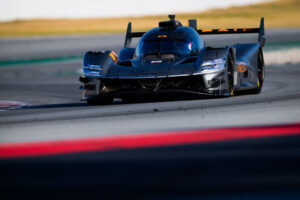
How important of a milestone is the engine passing 8,000 kilometers during the Barcelona test?
It’s a big milestone because it shows that it’s possible, that there is nothing fundamentally wrong in the engine and in our development decisions. It’s a clear demonstration of the capacity of our powertrain group to deal with very short timelines, but also some challenging early days and issues for which measures were developed successfully, and in time.
It’s obviously a motivation, because we know we have a product that has the capacity to reach the level we need. Quality control will be essential to make sure that it’s not just a one off, but something that we can fully reproduce, and that powertrain technology becomes one of the recognized strengths of Genesis Magma Racing.
How does what the team has achieved compare to the goals that were set at the start of the year?
If I look at what we had to deliver, I think we delivered extremely well, but it will always be relative to where the bar is placed by our competitors, and we will only be able to find that out next year. In the GMR-001 Hypercar we have a car that has clearly strong potential. The team is new but filled with individuals with huge amounts of experience in various categories. And finally, our line-up of drivers is a very strong balance of three champions – André Lotterer, Pipo Derani and Mathieu Jaminet, an exciting rising star in Mathys [Jaubert], and very established professional drivers with Paul-Loup [Chatain] and Dani [Juncadella]. We have exactly what we need – now it’s up to us to make the best out of it.
What are the next steps for the team and the car development in the first part of 2026?
There will be more test days before the first race. It’s about trying to do as much as we can before the car goes through homologation, because then any changes will be more limited. That’s why the start of the year will be extra busy. We need to have many more iterations on the software side, so that will be very much the focus, as well as working on all the procedures that will be critical when the season starts.
Our target for the start of the year is for us to have both a car and team – including the drivers – that are reliable, making no mistake, focus on completing the race. If we can do that, then it will be about building competitiveness. Once again, it is all about planning for building the very solid foundations we will need in the years to come.
Explore: Tire intelligence reimagined: Sensing Core hits the track